Immediate (same-day) implant placement means that the implant is placed into the bone on the same day the tooth is extracted – without waiting for the tooth socket to heal. It works only when specific conditions are met: enough bone around the socket, no acute purulent inflammation and sufficient primary stability of the implant. If these conditions are missing, the solution is the classic, delayed implant procedure. At the Happydent dental clinic we assess every case individually based on a CT scan – we never decide on visual assessment alone.
What “same-day implant placement” actually means
Same-day implant placement (in professional terms immediate implant placement) is a procedure in which the dentist does not wait for the bone to heal after tooth extraction. Instead, right after the root is removed, the implant is placed directly into the tooth socket. The whole procedure – extraction and implant placement – takes place in one visit.
It is important not to confuse two terms:
- Immediate implant placement – the implant is placed into the socket right after extraction, but the load (the crown) comes later, after healing.
- Immediate loading (“teeth in one day“) – a temporary crown or denture is also fitted on the implant on the same day.
These two procedures can be combined, but only if the implant reaches sufficient primary stability right at placement. Without it, immediate loading is not recommended.
Immediate implant placement shortens treatment by months, but it is not a universal solution – it is a procedure for carefully selected patients with suitable anatomy.
When immediate implant placement is possible – three basic conditions
1. Enough bone around the tooth socket
The walls of the tooth socket (especially the buccal, i.e. outer, wall) must be intact. If the wall is broken, very thin or part of the bone is lost during extraction, the dental implant has nothing to rest on, and it may shift or its surface may become exposed (dehiscence).
The buccal wall should be at least about 1–2 mm thick – with a thinner wall the risk of resorption (gradual loss of bone) after the procedure grows. This can only be assessed on a CT scan, not on a classic X-ray.
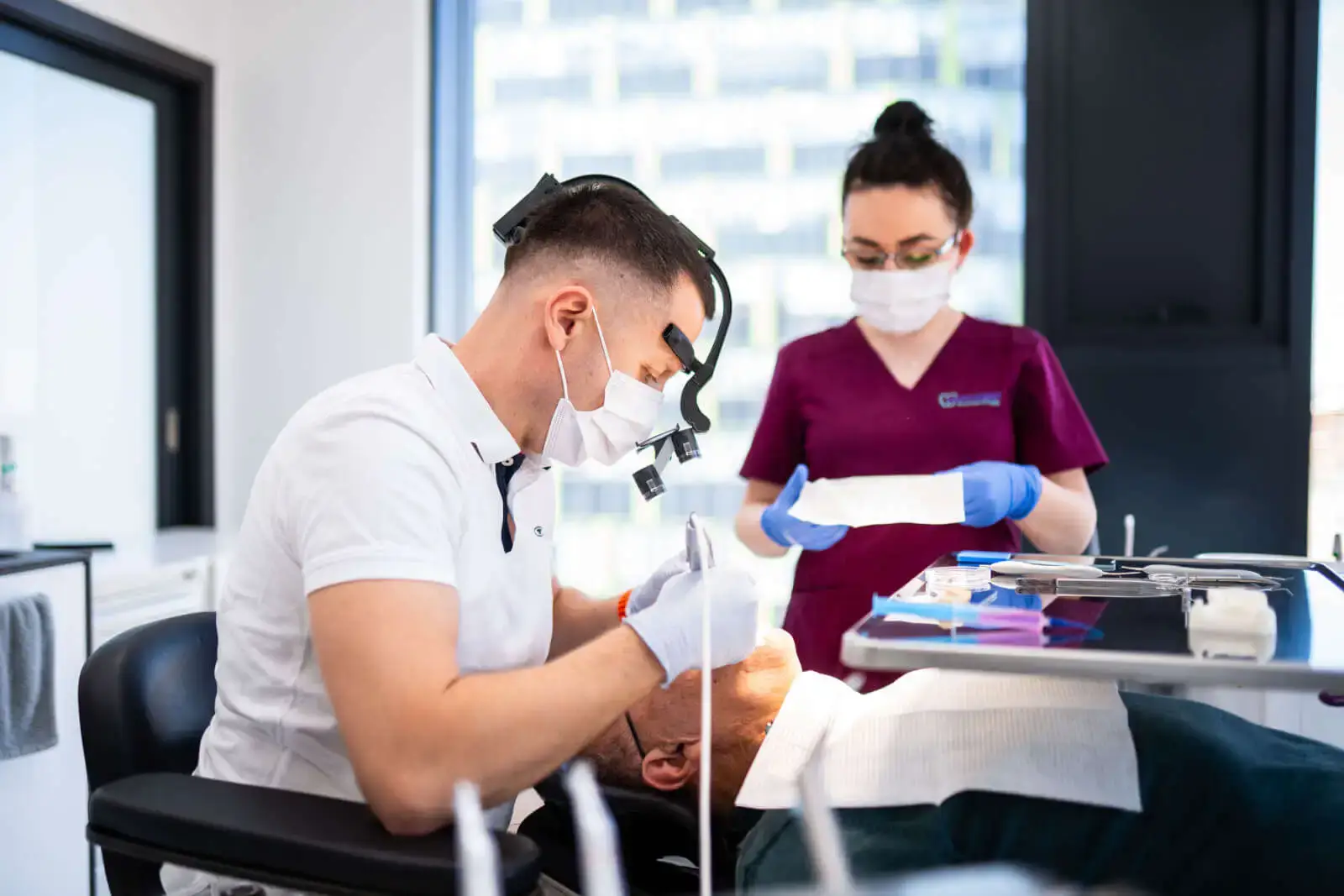
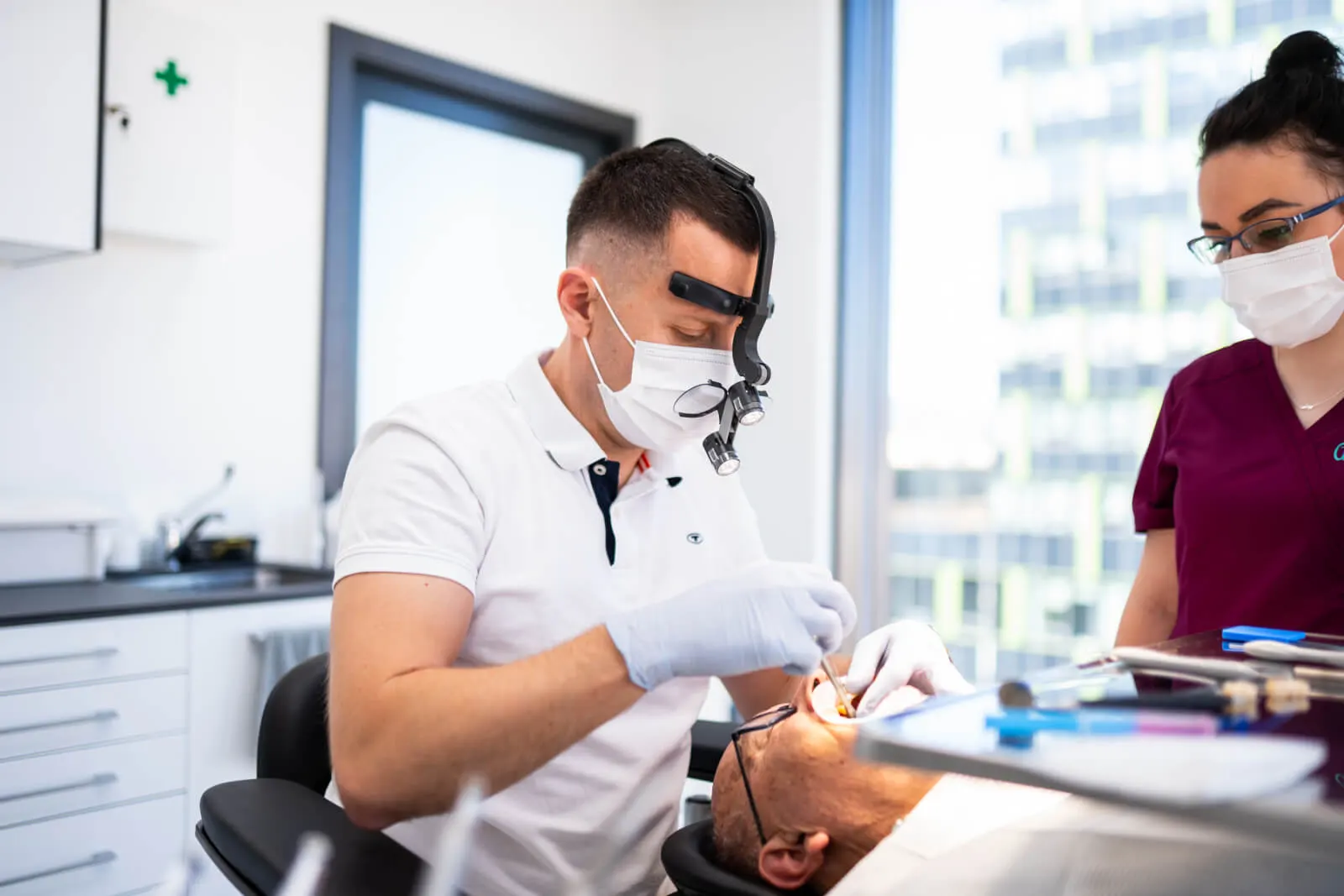
Dr. Repaši at work
2. No acute purulent inflammation in the area
If there is acute purulent inflammation (an abscess, an active fistula with discharge), the implant is not placed into the infected socket – the risk that osseointegration (the implant growing together with the bone) fails is too high. In such cases the infection and the extraction are dealt with first, and the implant comes later.
Chronic, inactive inflammation without active pus (for example a chronic periapical granuloma without acute symptoms) is assessed by the dentist individually. In some cases the socket can be thoroughly cleaned (curettage) and the implant placed in the same visit; in others it cannot.
3. Sufficient primary stability of the implant
Primary stability is the mechanical “hold” of the implant in the bone right after placement, before biological osseointegration. It is measured by the insertion torque, usually in newton-centimetres (Ncm), or with a device that measures ISQ (implant stability quotient).
In professional literature, a torque of about 30–35 Ncm is often given as a guide value for safe immediate loading. At lower values the implant is left to heal without being loaded with a crown, even if it was placed immediately after extraction.
When immediate implant placement is not suitable
The most common contraindications we see in practice:
- acute purulent inflammation or an abscess in the extraction area,
- a significant defect or fracture of the socket wall during extraction,
- not enough bone in depth and width (confirmed on CT),
- uncontrolled diabetes or another uncontrolled systemic disease that affects healing,
- heavy smoking (smoking alone is not an absolute contraindication, but it greatly increases the risk of failure),
- some medicines that affect bone metabolism,
- active, uncontrolled gum disease (periodontitis) in the whole mouth.
In these cases the classic procedure is chosen: extraction, healing of the soft and hard tissues (usually several months), if needed soft and hard tissue grafting or bone augmentation, and only then implant placement.
Immediate implant placement vs. the classic (delayed) procedure
| Criterion | Immediate implant placement | Classic (delayed) procedure |
|---|---|---|
| Visits for placement | Extraction + implant in one visit | Extraction and implant placement separately |
| Time until the implant is placed | On the day of extraction | Usually 2–6 months after extraction |
| Anatomical requirements | High – intact socket wall, enough bone | Lower – bone can be added by augmentation |
| Risk of failure if the case is chosen wrongly | Higher | Lower |
| Total treatment time to the final crown | Shorter | Longer |
| Suitability with infection | Not suitable with acute inflammation | Suitable – the infection is treated before the procedure |
How the procedure works step by step
- Initial examination and CT. No decision about immediate placement is made without a 3D scan. The CT shows the thickness of the socket walls, the volume of bone and how close important structures are (the nerve canal, the maxillary sinus).
- Gentle extraction. The tooth is removed with a technique that protects the socket walls as much as possible (atraumatic extraction). A traumatic extraction can destroy the conditions for immediate placement before it even starts.
- Placing the implant. The implant is placed into the socket, often slightly shifted towards the palatal/lingual wall, so that it uses the patient’s own bone instead of the thinner buccal wall.
- Filling the gap. The space between the implant and the socket wall is usually filled with bone substitute material to support healing.
- Measuring primary stability. The measured torque decides whether a temporary crown can be fitted straight away (immediate loading) or whether the implant is left to heal without load.
- Check-ups and the final crown. After healing (usually within several months), an impression is taken and the final prosthetic work is fitted.
The quality of the extraction decides success before the implant itself is even placed – a socket wall damaged by a rough extraction can rule out immediate placement completely.
During the procedure you are under local anaesthesia and mainly feel pressure and vibration. A single implant in Košice costs from €600; you will find all prices for Košice and Chorvátsky Grob on the dental implant page.

The All-on-4 implant system
All-on-4 and All-on-6: complete dental reconstruction in one day
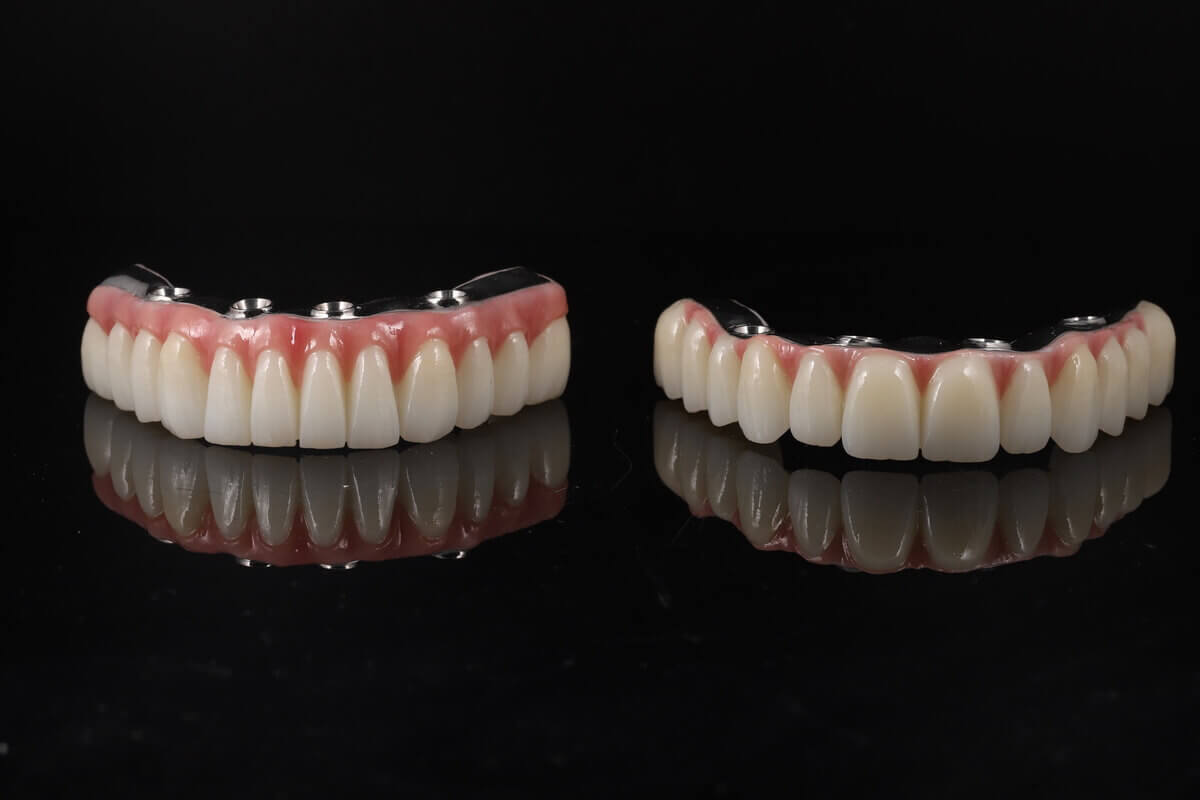
When all or almost all teeth in one jaw are lost, immediate implant placement is combined with the All-on-4 and All-on-6 protocols. The principle is the same as for a single tooth, only on a larger scale:
- All-on-4 – the whole arch of teeth rests on four implants. The two back implants are usually placed at an angle (tilted). This uses the available bone even where a straight implant would hit the sinus or the nerve canal, and it lengthens the span of the bridge without more implants at the back.
- All-on-6 – the same principle with six implants, which usually means better distribution of chewing forces, especially for larger or longer prosthetic work.
The choice between four and six implants depends on the volume and quality of the bone and on the planned type of prosthesis.
At the Happydent dental clinic we always start with a CT scan of the whole jaw. Only then do we suggest whether All-on-4, All-on-6 or a combination with bone augmentation is more suitable. All-on-4 in Košice costs from €6,000.
Risks and possible complications
Even when all conditions are met, immediate implant placement carries some risks that the patient should know in advance:
- Resorption of the buccal wall – even with an intact wall, part of the bone volume is naturally lost after extraction. Immediate placement reduces this risk but does not remove it completely.
- Insufficient primary stability – if the bone turns out to be softer during the procedure than the CT showed, the implant is not loaded and the plan changes during the visit.
- Failure of osseointegration – in general comparable with the classic procedure when the case is chosen correctly, but higher in wrongly indicated cases.
- Gum recession around the implant, especially in the aesthetic zone (front teeth), if the soft tissue is thin.
Care after the procedure and healing
The first days after the procedure are decisive for the result:
- avoid chewing on the treated side until the dentist allows it,
- follow the prescribed hygiene – gentle mouth rinses, no aggressive brushing directly at the implant,
- if a temporary crown was fitted (immediate loading), do not overload it (hard, sticky food),
- come to check-ups exactly as planned, even if nothing hurts – healing is checked clinically and on X-rays.
Full osseointegration usually takes several months. The exact time depends on the quality of the bone, the position of the implant and how the patient heals.
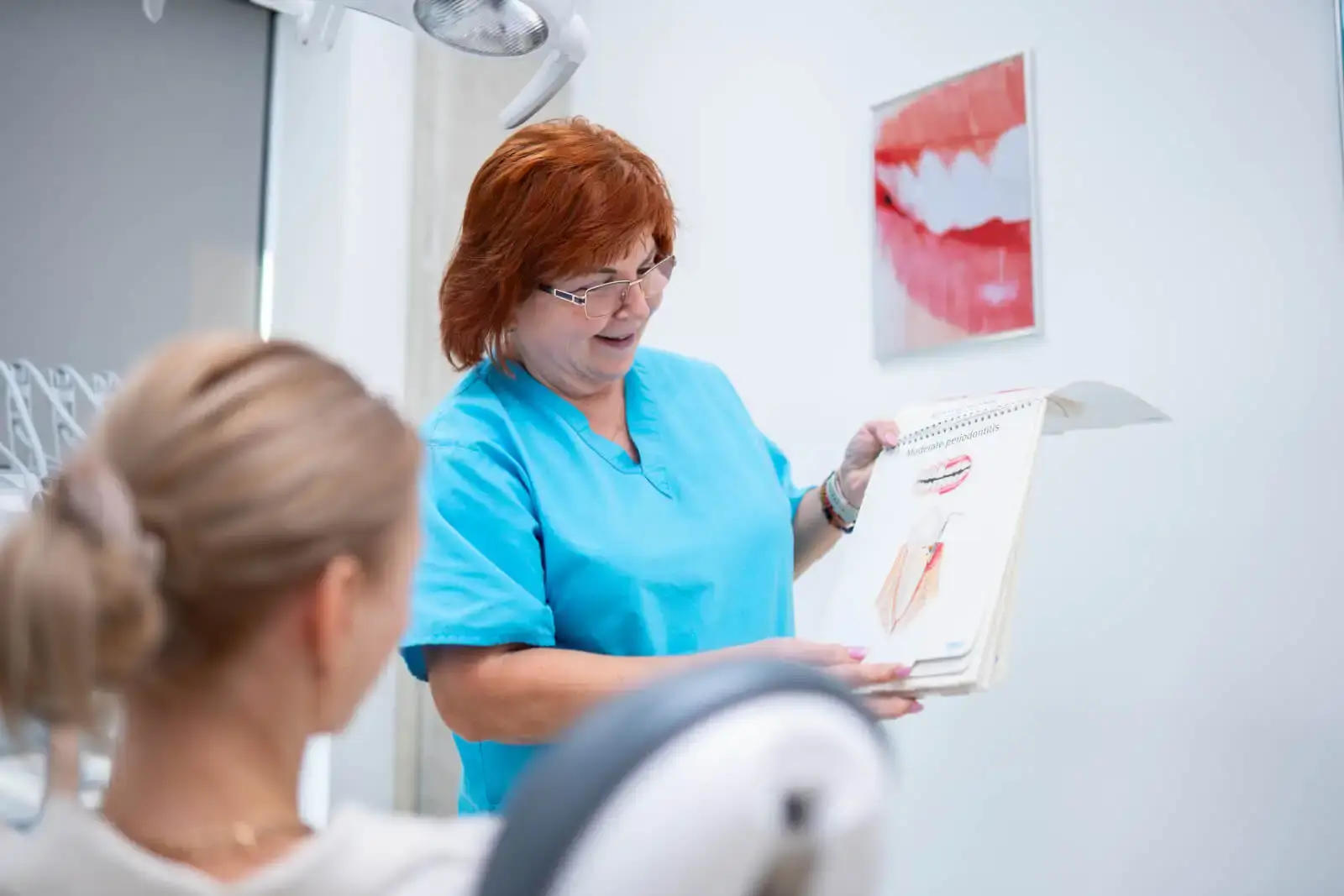
The dentist explains the procedure to the patient
Frequently asked questions
Is immediate implant placement the same as “teeth in one day”? Not always. Immediate placement means that the implant is placed on the day of extraction. “Teeth in one day” also means that you get a temporary crown or denture on the same day – this is possible only if the implant has sufficient primary stability.
If I have inflammation, does it mean immediate placement is ruled out for me? No. It only means that it is not suitable at that moment. Once the inflammation is treated and the bone has healed, classic implant placement is still a full option.
Do I need a CT scan, or is a normal X-ray enough? A CT scan is essential for deciding on immediate placement – a normal 2D X-ray does not show the thickness of the socket walls or the exact volume of bone in all directions.
Can immediate placement fail during the procedure itself? Yes. If the socket wall is damaged during extraction or the bone does not give enough stability, the dentist may decide on delayed placement during the visit. We explain this to the patient in advance as one of the possible courses of treatment.
If you are considering an implant after an extraction, book a consultation in Košice or Chorvátsky Grob.
 Facebook